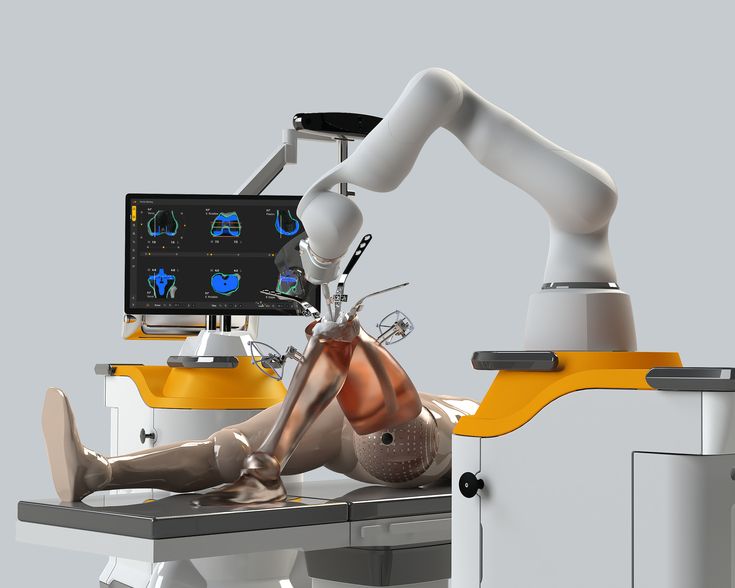
Knee replacement surgery has transformed the lives of millions of people suffering from severe joint pain, arthritis, or knee degeneration. While traditional knee replacement has been successful for decades, advanced robotic systems have raised the bar for accuracy, safety, and long-term results. Patients today increasingly choose robotic-assisted knee replacement for better precision, faster recovery, and a more naturally feeling knee after surgery. However, many patients still wonder what exactly are robotic systems and how do they help in knee replacement. Let’s understand it in simple words and without getting into technical detail.
What are robotic systems in knee replacement?
A robotic system in knee replacement is a very advanced tool that assists the surgeon during the procedure. It does not do the surgery on its own; rather, it acts like a smart assistant, upgrading the surgeon’s hands and allowing them to operate with extremely high precision.
Think of it as GPS navigation in a car: the driver still operates the car, but the GPS guides the route with precision. Similarly, robotic systems help the surgeon plan and execute surgery more perfectly than the human eye can manage.
How Do Robotic Systems Work? Step-by-Step
3D Scan of the Knee: Before surgery, the robotic system creates a 3D model of the patient’s knee, showing exactly where the joint is damaged.
Personalized Surgical Plan: This system helps the surgeon decide:
- Where to place the implant
- How much bone should be trimmed
- How to balance surrounding ligaments
Real-time Guidance during Surgery: During the procedure, a robotic arm or sensor is tracking every motion while keeping the surgeon within perfect alignment and safety boundaries.
This ensures the implant fits naturally, like a tailor-made joint.
Types of Advanced Robotic Systems Used in Knee Replacement
There are many types of robotic systems in use in hospitals today. Each has specific features, but all share the common goal of improving accuracy and patient outcomes.
The three broad categories are simplified as follows:
1. Robotic-Arm Assisted Systems
These systems are the ones most in use. A robotic arm is controlled by the surgeon, guiding cutting and implant positioning according to predefined accuracy levels.
Helps avoid cutting too much bone
Protects soft tissues from injury
Ensures exact alignment of the implant.
These systems reduce error significantly and promote faster recovery.
2. Image-Based Systems (CT or MRI-Guided)
In these systems, pre-operative scans are carried out in great detail. The data is fed into the robot to create a 3D model of the knee.
- Allows detailed personalized planning
- Helps foresee the best implant size and orientation
- Useful for complex deformities and long-standing arthritis
- This technique improves the longevity of the implant and long-term comfort.
3. Image-Free Smart Sensors
In this case, the robot collects actual-time information during surgery instead of depending on pre-operative scans.
- Instantly maps the joint
- Adjusts the plan during surgery when the knee moves
- Balances the ligaments dynamically to ensure natural knee motion.
- These systems are highly advanced and help to create a very natural feel after surgery.
Why Robotic Systems Improve Patient Outcomes
Robotic systems are much more than just about technology; they dramatically improve the patient’s recovery and quality of life. Major benefits include:
- Less tissue damage during surgery
- Reduced post-operative pain
- Faster return to walking and daily activities
- Better knee flexion and flexibility
- Lower complication or misalignment chances
- Prolonging the life of the knee implant
In short, robotic systems make knee replacement safer, smoother, and more reliable.
Who Benefits Most From Robotic-Assisted Knee Replacement?
This approach is beneficial in that:
- Patients with advanced arthritis
- People who are seeking long-term implant outcomes
- Active persons or athletes
- Young patients who expect high mobility
- Patients who have had knee surgery in the past that has failed
- People with deformities or complex knee conditions
Almost anyone who is eligible for knee replacement can benefit from robotics.
Conclusion Robotic systems for knee replacement mark one huge leap in modern orthopaedic surgery. Merging the skill of an experienced surgeon with the precision of state-of-the-art technology, robotic-assisted knee replacement offers matchless precision, minimal tissue damage, faster recovery, and a knee that feels more natural and comfortable. Though the technological phase of robotics is very advanced, the expertise of a surgeon operating it remains the most important factor. Consider consulting with a properly trained and trusted robotic knee replacement specialist if you’re thinking about knee replacement to get the best results. Dr. Saurabh Giri is a Pune-based Joint Replacement and Arthroscopy Specialist renowned for doing surgeries related to the knee, hip, and sports injuries. He is a leading robotic knee replacement surgeon with a track record of successful results using advanced surgical technology
Recent Posts
-
 Ignoring Advanced Surgical Options While Robotic Knee Replacement Continues Becoming the Future of Joint Care
 -
 Not because the pain was manageable, but because he was afraid of surgery.
 -
 Still Worried About Long Recovery Periods and Limited Mobility After Knee Replacement Surgery
 -
 Why Traditional Knee Surgery Is Gradually Losing Preference in the Era of Robotic Orthopedic Procedures
 -
 Afraid of Knee Replacement Surgery Due to Fear of Pain, Recovery Time, and Surgical Complications